
Agnes
Email:saler3@kinscoter.com
Whatsapp:+86 16676870193
Mobile:+86 16676870193
Office: +86-768-2217942
WeChat: ik_THKJ1
When developing a new rechargeable handheld fan, one of the decisions that should be made before the exterior design is finalized is the battery configuration.
For many handheld fan projects, two common options are one 21700 battery or two 18650 batteries. At first, this may appear to be mainly a battery-capacity or runtime decision. In practice, however, battery selection directly affects the physical space available inside the handle and can therefore influence the final appearance of the product.
The battery configuration can affect handle width, thickness, length, internal component arrangement and even the visual proportion between the fan head and the handle. Battery capacity and cell type can also affect the product BOM and final cost.
For OEM and ODM handheld fan development, the practical rule is simple: confirm the battery type and approximate capacity before finalizing the industrial design.
Buyers preparing a new portable fan project can also use our portable fan product brief to organize battery, runtime, target size, target cost and other early development requirements before detailed design begins.
A handheld fan handle may look simple from the outside, but the available internal space must accommodate several components.
Among these components, the battery occupies a significant amount of physical space. If the industrial designer develops a slim handle around one battery configuration and the battery solution is changed later, the existing exterior may no longer provide enough internal room.
A battery change may therefore require the development team to reconsider handle width, handle thickness, internal supports, battery fixation, PCB positioning, wiring layout and the overall exterior proportions.
Battery selection is therefore not simply a component-purchasing decision. It is one of the basic constraints of the product architecture.
For a broader explanation of what should be confirmed during this stage, see what buyers should confirm before industrial design .
18650 and 21700 are different cylindrical lithium-ion battery formats. For the handheld fan projects discussed here, the more practical comparison is not one 18650 cell versus one 21700 cell, but rather:
1 × 21700 battery
versus
2 × 18650 batteries
These two configurations occupy the internal space of a handheld fan handle differently and therefore create different design envelopes.
A single 21700 solution places one larger cylindrical cell inside the handle.
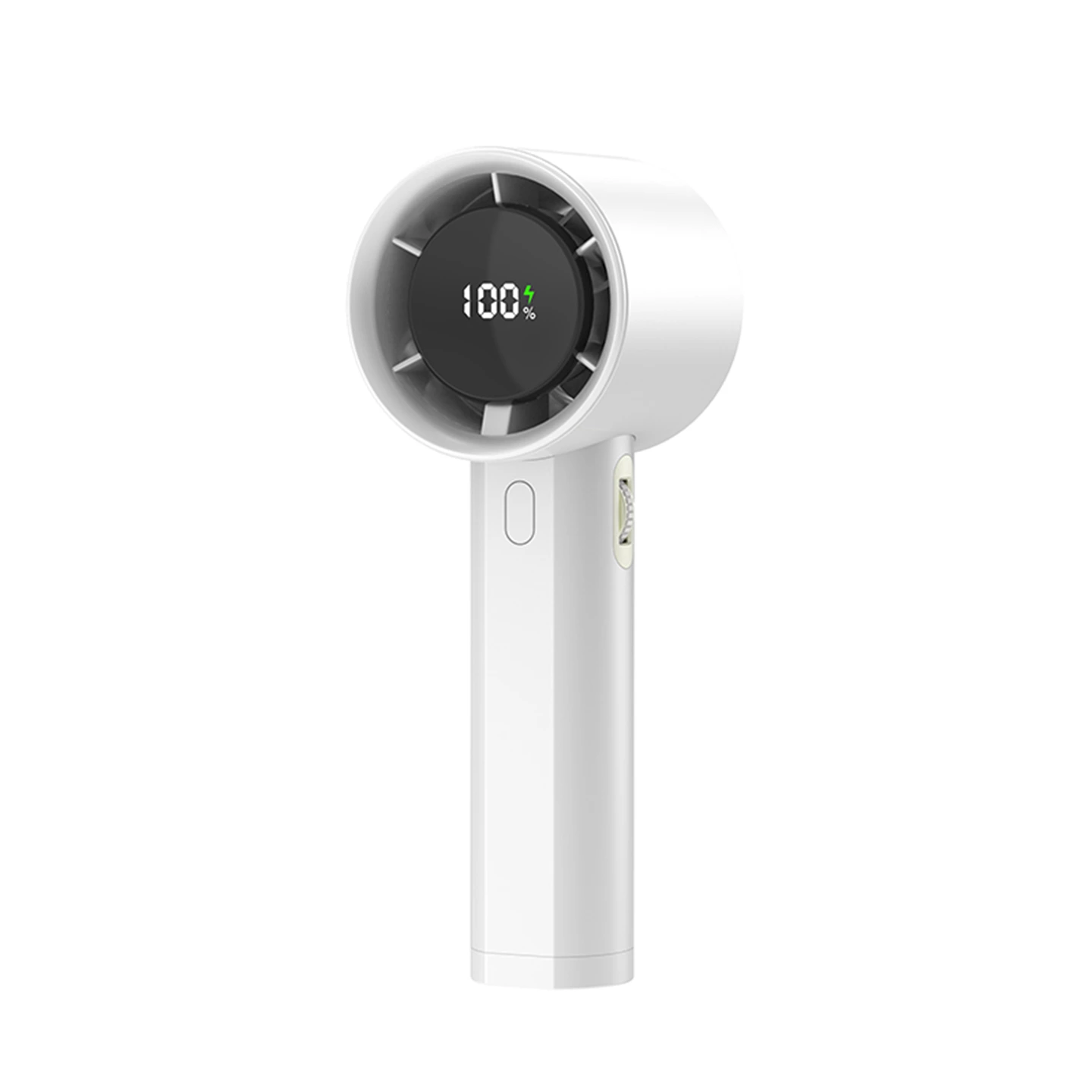
From an industrial-design perspective, the handle must provide enough internal space for the battery while maintaining appropriate plastic wall thickness, structural support and room for surrounding electronic components.
Because only one cylindrical cell needs to be arranged, the battery area can be concentrated around one central battery envelope. The designer can then develop the handle proportions around this known internal volume.
A dual-18650 configuration uses two smaller cylindrical cells instead of one larger cell.
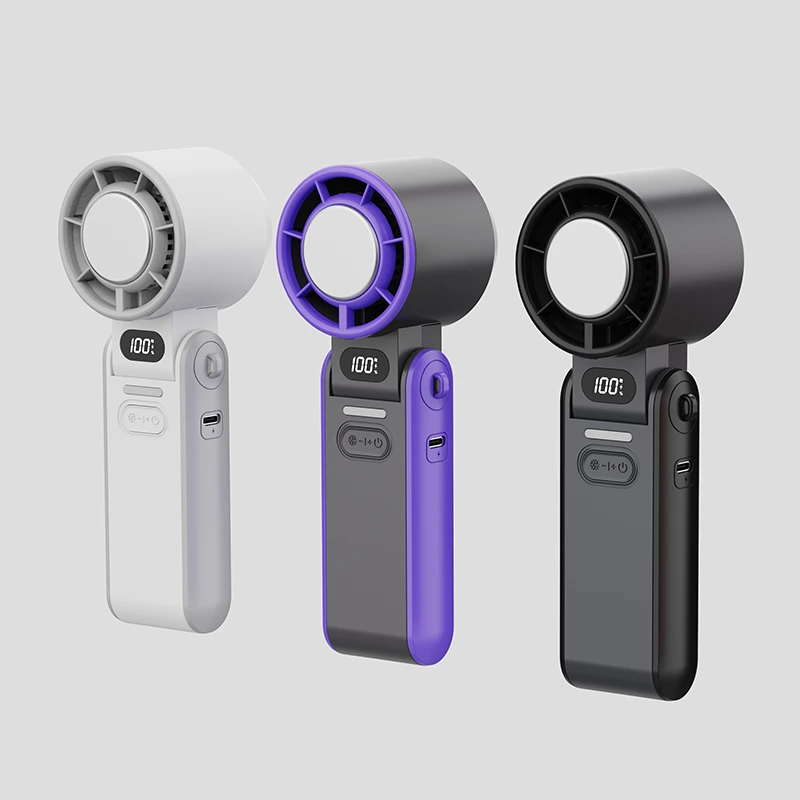
Although each individual 18650 cell is narrower than a 21700 cell, the product must accommodate two batteries. Depending on how the cells are positioned, this can require a wider, thicker or flatter internal battery area.
For example, when two cells are arranged side by side, the cross-section of the handle may become wider. This may lead to a different exterior design direction from a product developed around one centrally positioned 21700 cell.
The important question is therefore not simply “Which battery is smaller?”
A more useful development question is: “What handle shape does the complete battery configuration require?”
For a handheld consumer product, relatively small dimensional changes can noticeably affect the overall appearance.
The industrial designer needs to balance the fan-head diameter, handle width, handle thickness, handle length, button position, display position and the transition between the fan head and handle.
The battery establishes physical boundaries around these decisions.
For example, a compact fan head combined with a very thick handle may create an unbalanced visual proportion. Similarly, a concept intended to have a narrow cylindrical grip may be difficult to execute if the selected battery configuration requires a much wider internal cross-section.
This is why battery architecture and industrial design should be considered together rather than treated as two independent stages.
If the product concept is developed around a single 21700 battery from the beginning, the designer can establish the basic handle dimensions around the required cylindrical battery envelope.
The external surfaces, grip shape and transition into the fan head can then be refined while maintaining sufficient internal space.
If two 18650 batteries are selected, the designer needs to consider how both cells will be positioned.
A side-by-side arrangement may naturally lead toward a wider or flatter handle. Another internal arrangement may result in different thickness or length requirements.
This does not mean that one configuration produces a better-looking product than the other. It means that the selected battery architecture should support the intended design language.
One of the avoidable problems in custom product development is approving the exterior before important internal components have been sufficiently defined.
For example, suppose a handheld fan appearance is created around a single 21700 battery. Later, the project changes to two 18650 batteries because of cost, sourcing or capacity considerations.
The engineering team then needs to check whether the new battery configuration can fit inside the approved handle.
If it cannot, changes may be required to the internal layout, handle dimensions, exterior surfaces and structural data.
Once the product enters engineering sample development , the battery must also be coordinated with the motor, PCB, charging system, wiring and internal supports. A late battery change can therefore affect considerably more than the battery compartment itself.
Confirming the battery architecture earlier helps reduce unnecessary design iterations before tooling.
Battery type is only part of the decision. Buyers should also establish the approximate capacity target before the handle design is locked.
| Battery Configuration | Current Capacity Options for Comparison |
|---|---|
| 1 × 21700 | 3000 mAh / 3500 mAh / 4000 mAh |
| 2 × 18650 | 3000 mAh / 3600 mAh / 4000 mAh |
The exact battery specification should be determined according to the product requirements and final engineering solution.
From a development-process perspective, a more practical sequence is:
Performance and product requirements → battery type and capacity → industrial design → structural engineering.
This gives the industrial designer a more reliable physical envelope before the final exterior is approved.
Battery capacity is naturally related to the expected operating time of a rechargeable handheld fan, but the mAh value alone does not determine final runtime.
Actual operating time also depends on the motor, fan speed, control strategy, electrical load and operating mode.
A high-speed handheld fan running at maximum output will consume energy differently from the same product operating at a lower speed.
For this reason, buyers should consider three requirements together:
Product size + performance target + battery capacity.
If a project simultaneously requires an extremely slim handle, high maximum airflow and long runtime, the engineering team may need to balance these requirements during development.
Battery architecture also affects the product BOM and should therefore be considered before the product design is finalized.
Based on the current reference pricing used for this comparison, the cost difference between the two battery configurations varies depending on capacity.
| Battery Configuration | Capacity | Reference Price |
|---|---|---|
| 1 × 21700 | 3000 mAh | RMB 4.50 |
| 1 × 21700 | 3500 mAh | RMB 6.20 |
| 1 × 21700 | 4000 mAh | RMB 7.80 |
| 2 × 18650 | 3000 mAh | RMB 4.30 |
| 2 × 18650 | 3600 mAh | RMB 4.80 |
| 2 × 18650 | 4000 mAh | RMB 6.00 |
At the matched 3000 mAh capacity level, the reference difference is relatively small: RMB 4.50 for the 21700 configuration compared with RMB 4.30 for the dual-18650 configuration.
At 4000 mAh, the difference is more noticeable: RMB 7.80 for the 21700 configuration compared with RMB 6.00 for the dual-18650 configuration.
For a production order, even a relatively small component-price difference becomes part of the total unit BOM and should be evaluated together with the intended product positioning and target purchase price.
The goal is therefore not simply to select the lowest-cost battery. The battery solution should satisfy both the intended exterior design and the commercial requirements of the project.
Pricing note: The battery prices shown above are for reference and comparison purposes only. They are not formal quotations. Actual battery pricing may vary depending on the selected cell specification, supplier and purchasing conditions.
| Evaluation Point | 1 × 21700 | 2 × 18650 |
|---|---|---|
| Number of cells | 1 | 2 |
| Internal layout | One larger cylindrical cell | Two smaller cylindrical cells |
| Handle design impact | Handle designed around one larger battery envelope | Handle must provide space for two cells and their arrangement |
| Possible appearance direction | Can support a design centered around one cylindrical battery volume | May result in a wider or flatter layout depending on cell arrangement |
| Current capacity options | 3000 / 3500 / 4000 mAh | 3000 / 3600 / 4000 mAh |
| Reference price at 3000 mAh | RMB 4.50 | RMB 4.30 |
| Reference price at 4000 mAh | RMB 7.80 | RMB 6.00 |
There is no universal winner in this comparison. The appropriate configuration depends on the required handle shape, product proportions, capacity, performance requirements and target cost.
Confirm whether the product will be developed around a 21700 battery or an 18650 battery configuration.
For the solutions discussed in this article, the comparison is one 21700 battery versus two 18650 batteries.
Determine the required capacity range before fixing the final handle dimensions.
If the product is expected to have a particularly narrow, slim, flat or compact handle, this design direction should be evaluated together with the battery arrangement.
Battery capacity should be considered together with the motor, operating modes and expected runtime rather than as an isolated specification.
Battery pricing should be included in the BOM discussion at the beginning of the project rather than after the exterior design has already been approved.
For rechargeable handheld fans, battery selection is often discussed mainly in terms of capacity and runtime. During early product development, however, there is another important consideration: the battery physically shapes the product.
The relationship can be summarized as:
Battery type and quantity → internal battery layout → handle width and thickness → overall product proportions → final appearance
At the same time:
Battery type and capacity → component cost → product BOM → market positioning
After the exterior has been confirmed, the battery and other internal components still need to be validated through structural and functional development. Buyers who want to understand these approval stages can review the differences between an appearance prototype, engineering functional prototype and T0 sample .
Choosing between a 21700 battery and a dual-18650 configuration is not simply a technical battery specification for a handheld fan.
The selected battery architecture can influence the handle width, thickness, internal structural layout, exterior proportions, available capacity options and product cost.
For brands, importers and OEM/ODM buyers developing a new handheld fan, battery type and approximate capacity should therefore be confirmed during the early product-definition stage.
Doing so gives the industrial designer and structural engineer clearer design boundaries and reduces the risk of modifying the handle after the appearance direction has already been approved.
If you are planning a custom handheld fan project, Chaozhou Tongheng Technology Co., Ltd. can discuss the intended battery configuration, capacity requirement, handle direction, performance target and product positioning before detailed industrial design begins.
Yes. For a custom handheld fan, battery dimensions and cell quantity directly affect the internal battery area and therefore influence the available handle dimensions. Confirming the battery architecture early gives the industrial designer a clearer physical design envelope.
A single 21700 configuration requires the handle to provide space for one larger cylindrical battery. The handle dimensions and surrounding internal structure need to be developed around this battery envelope.
Two 18650 batteries require space for two cylindrical cells. Depending on their arrangement, the handle may require additional width, thickness or a flatter cross-section.
In the current reference pricing used in this article, the 21700 configurations cost more than the dual-18650 configurations at the matched 3000 mAh and 4000 mAh capacity levels. Actual production pricing must still be confirmed according to the specific battery cells selected.
It may be possible, but the handle structure and exterior may need to be revised if the new battery configuration cannot fit within the approved internal space. Changes made later in engineering can also affect development work and potentially tooling.
They should be considered together during product definition. The intended appearance establishes the design direction, while battery type and capacity provide important physical and commercial constraints that the final product must accommodate.
Tell us about your product or OEM/ODM requirements — our team will respond within one business day with product recommendations and manufacturing solutions.
Pick the specialist for your business — we reply within one business day.
Agnes
Email:saler3@kinscoter.com
Whatsapp:+86 16676870193
Mobile:+86 16676870193
Office: +86-768-2217942
WeChat: ik_THKJ1

Tina Chen
Email:sales2@cztongheng.com
Whatsapp:+86 152 1853 1931
Mobile:+86 152 1853 1931
Office: +86 768 221 7942
WeChat: czkinter

Charmy Zhou
Email:saler1@kinscoter.com
Whatsapp:+86 138 2832 9041
Mobile:+86 138 2832 9041
Office: +86 768 221 7942
WeChat: ik-THKJ