
Agnes
Email:saler3@kinscoter.com
Whatsapp:+86 16676870193
Mobile:+86 16676870193
Office: +86-768-2217942
WeChat: ik_THKJ1
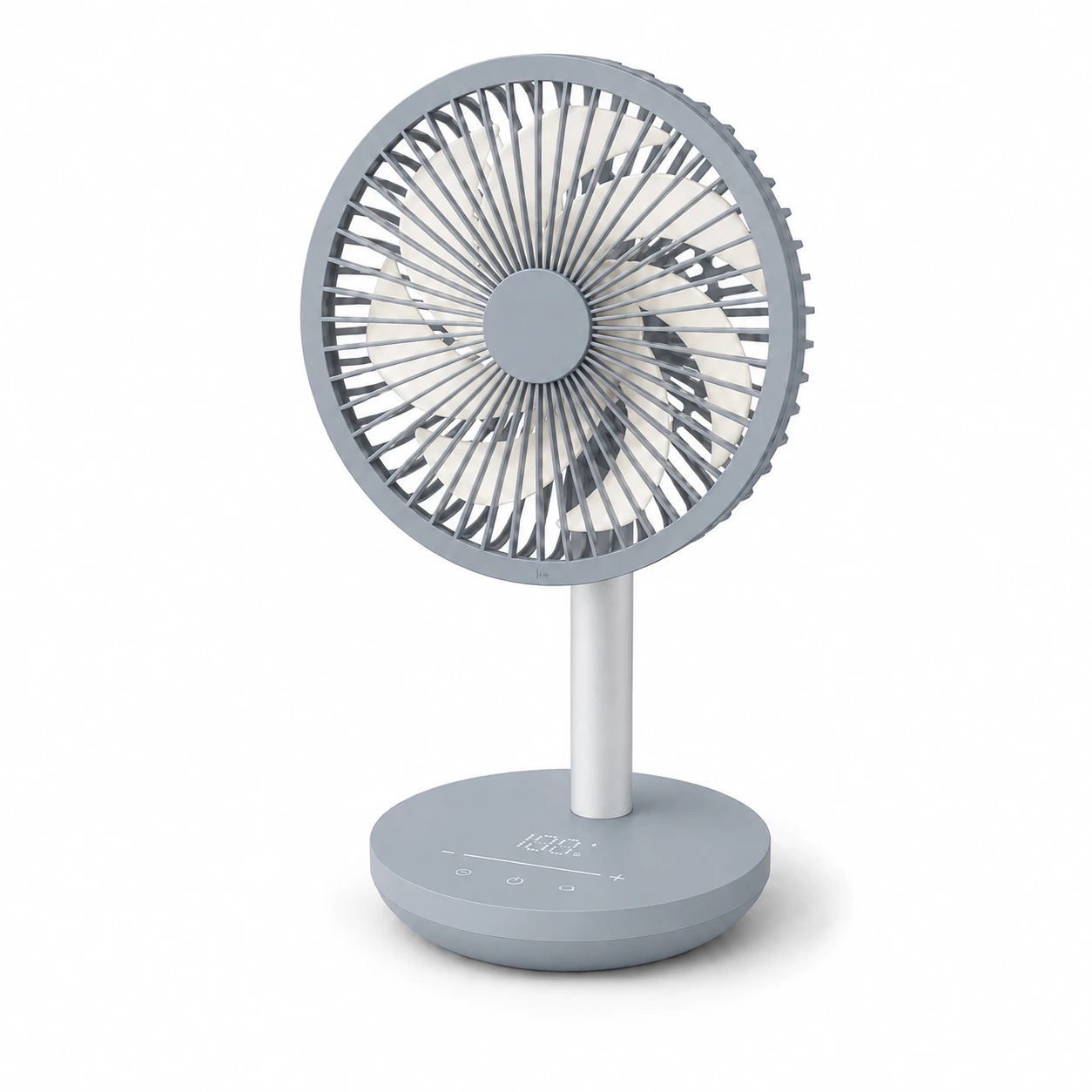
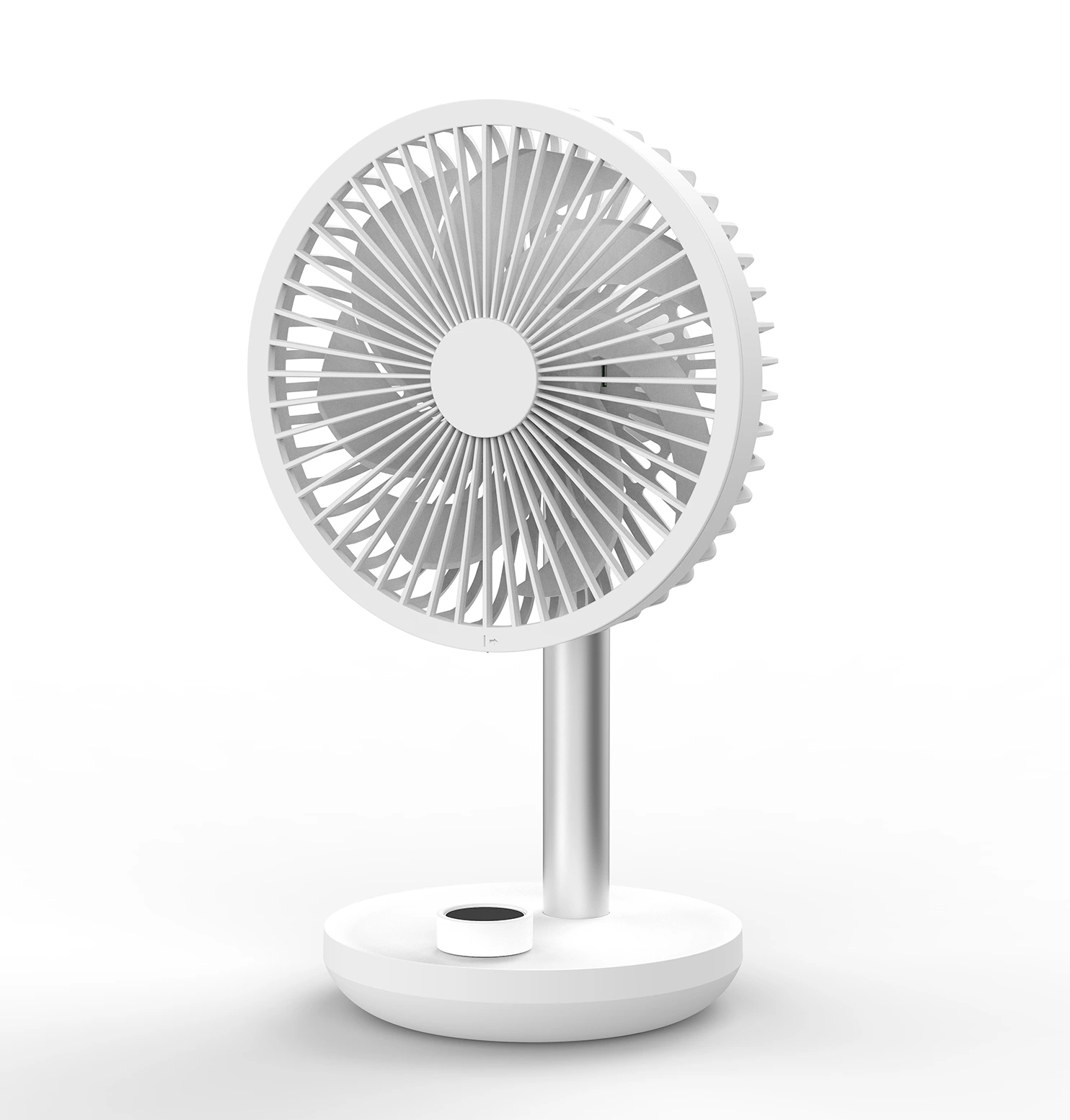
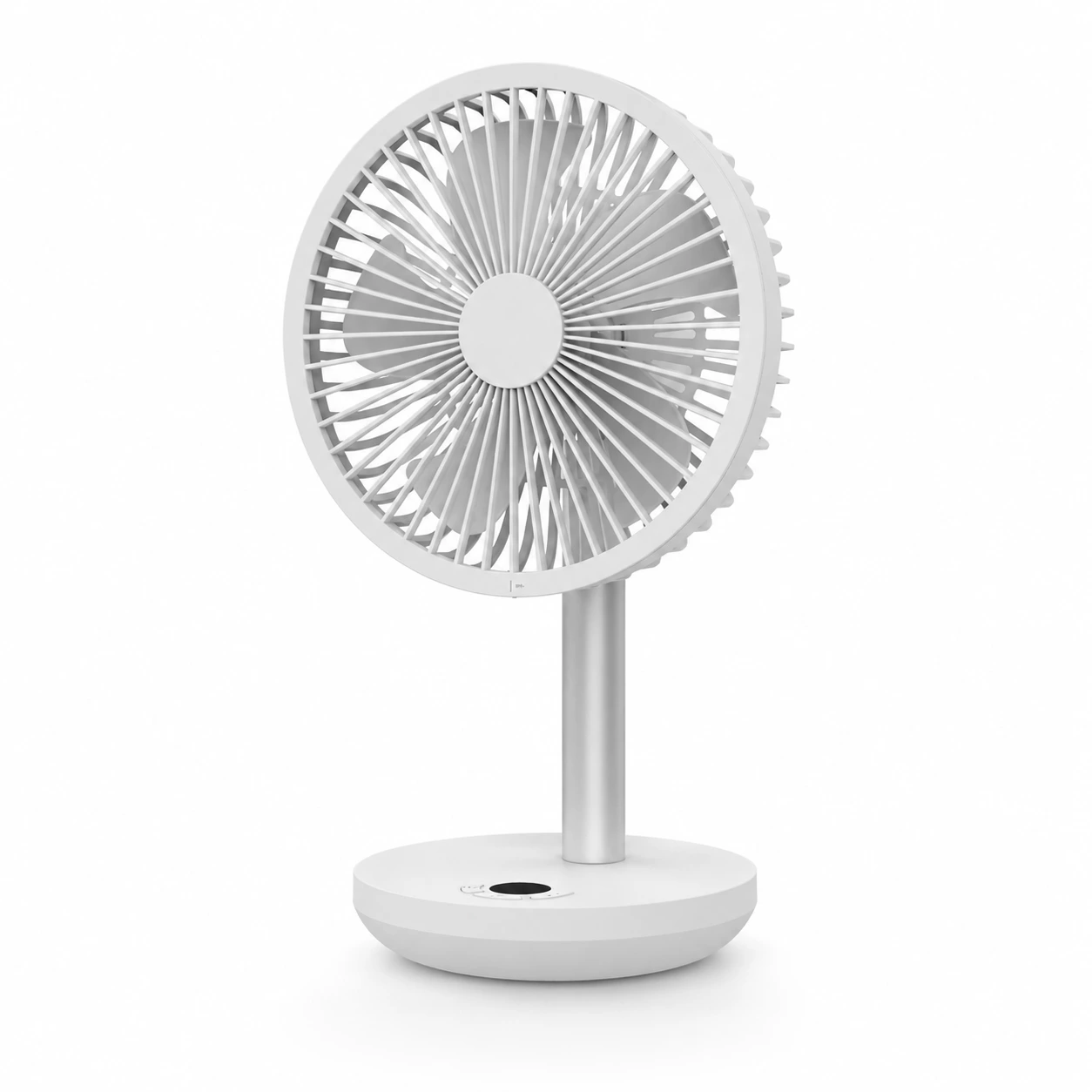
For 2027, Kinscoter is expanding its rechargeable oscillating desk fan range with two new models: the KC-F17S and KC-F17T. Both products build on the established KC-F17 format while introducing a seven-blade fan structure designed for quieter airflow.
The main distinction between the two new models is the user interface. The KC-F17S uses a rotary control, while the KC-F17T introduces tap-and-slide touch adjustment, an airflow indicator bar and a concealed display. This gives importers, distributors and retailers two clearly differentiated options for different product positions and sales channels.
The KC-F17 rechargeable oscillating desk fan was launched in 2026 with a five-blade structure and a conventional three-button control panel. It combines five airflow levels, automatic oscillation, timer control, a digital battery display and a removable front grille.
For 2027, the product platform develops in two directions:
The KC-F17S introduces rotary airflow control and a seven-blade structure.
The KC-F17T combines a seven-blade structure with touch adjustment, visual airflow feedback and additional interface functions.
The result is not simply a replacement for the KC-F17. It is a broader product family that allows buyers to select an operating style and feature set suited to their target customers.
| Feature | KC-F17 | KC-F17S | KC-F17T |
|---|---|---|---|
| Launch year | 2026 | 2027 | 2027 |
| Blade structure | 5 blades | 7 blades | 7 blades |
| Main control method | Three-button control | Rotary knob | Tap-and-slide touch control |
| Airflow adjustment | 5 levels | Stepless adjustment | Stepless touch adjustment |
| Maximum air speed | Approximately 4.5 m/s, ±10% | 4.6 m/s | 4.6 m/s |
| Battery capacity | 4,000 mAh | 4,000 mAh | 4,000 mAh |
| Maximum runtime | Up to 12 hours at Level 1 | Up to 12 hours at 1% with oscillation off | Up to 12 hours at 1% with oscillation off |
| Display and feedback | Digital battery display | Integrated display | Battery and charging display plus blue airflow indicator |
| Oscillation | Automatic oscillation with centering calibration | Selectable oscillating or fixed mode | Selectable oscillating or fixed mode |
| Timer | Available | To Be Confirmed | 1, 2, 4 and 6 hours |
| Sleep mode | To Be Confirmed | To Be Confirmed | Available |
| Airflow memory | To Be Confirmed | To Be Confirmed | Available |
| Front cover | Removable | Removable | Removable |
| Suggested positioning | Familiar button-operated model | Rotary-control model with quieter-oriented airflow design | Interface-focused model with visible touch interaction |
Actual airflow, runtime and acoustic performance may vary with the selected setting, battery condition and operating environment.
The KC-F17S is designed for buyers who want to update the operating experience without moving entirely away from physical controls.
Its rotary knob gives users a direct, tactile method of adjusting airflow. Compared with repeatedly pressing a button to move between fixed settings, rotary operation makes it easier to increase or reduce airflow in one continuous action. The product specification describes this as stepless speed adjustment.
The KC-F17S also changes from the five-blade structure used by the KC-F17 to a seven-blade arrangement. This design is intended to support smoother, quieter airflow for desks, bedside tables, study areas, counters and personal workspaces.
Published acoustic data for the KC-F17S records 39.7 dB at the 1% setting and 52.7 dB at the 100% setting. These figures describe the tested KC-F17S configuration and should not be treated as a direct numerical comparison with the KC-F17 unless both models are tested under the same conditions.
For retailers, the rotary control creates a feature that is easy to explain in product listings and in-store demonstrations. It may suit product ranges where buyers prefer visible mechanical interaction combined with a contemporary display and rechargeable operation.
The KC-F17T provides more visible interface differentiation within the 2027 series.
Instead of buttons or a rotary knob, users can tap a position or slide across the touch-control area to adjust airflow. A blue indicator bar changes in length to show the approximate airflow setting, making the adjustment process easy to understand visually.
The concealed display shows the remaining battery level during operation and a charging symbol while the fan is connected to power. This screen-under design keeps the control surface visually integrated while still providing useful operating information.
The KC-F17T also includes:
Selectable oscillating and fixed-airflow operation
1, 2, 4 and 6-hour timer settings
Sleep mode that switches off screen lighting
Airflow memory that restores the previous setting
A removable front cover for routine cleaning
These features give retailers multiple demonstration points for product photography, videos, livestreams and in-store displays. The touch panel and blue indicator bar are particularly useful for e-commerce content because their operation can be shown clearly in short-form video.
Like the KC-F17S, the KC-F17T provides a maximum air speed of 4.6 m/s and uses a 4,000 mAh rechargeable battery. Published runtime reaches up to 12 hours at the 1% setting with oscillation turned off.
Blade count alone does not determine overall fan performance. Motor design, blade geometry, rotational speed, grille structure and airflow path also influence air speed and operating noise.
Within this series, however, the move from five blades in the KC-F17 to seven blades in the KC-F17S and KC-F17T provides a clear product-development distinction. The seven-blade structure is intended to support a smoother and quieter airflow experience while retaining measurable air speeds of up to 4.6 m/s.
For B2B buyers, this creates a practical communication point for:
Bedroom and bedside product positioning
Office and study-room applications
Personal cooling at reception desks and counters
Quiet-oriented home appliance collections
Product demonstrations focused on comfort rather than air speed alone
Any direct claim that one model is quieter than another should be supported by testing under the same distance, speed, oscillation and environmental conditions.
The KC-F17 remains relevant for customers who prefer a conventional operating method. Its three-button panel, five airflow levels, timer, battery display and oscillation function are straightforward to explain.
It can support established retail programs that do not require a major interface change.
The KC-F17S is suitable when tactile rotary control and stepless airflow adjustment are important. Its seven-blade structure also provides a clear update from the KC-F17.
This model can be considered for home appliance, office accessory, lifestyle and rechargeable personal-cooling ranges where simple physical control remains desirable.
The KC-F17T is the appropriate option when visual interaction is a central part of the product presentation. Touch adjustment, the blue airflow indicator, screen-integrated feedback, timer settings, sleep mode and memory provide more content for retail demonstrations.
It is particularly relevant to e-commerce sellers, livestream channels and private-label brands seeking a desk fan with a more distinctive control interface.
Importers and distributors do not necessarily need to select only one model. The three products can also be used to create a coordinated desk fan collection:
KC-F17 for conventional button operation
KC-F17S for rotary adjustment and a seven-blade structure
KC-F17T for touch interaction and additional interface functions
This approach allows a retailer to serve different operating preferences while maintaining a coherent product category. It also creates clearer reasons for customers to move between models without relying only on colors or packaging changes.
Buyers should evaluate the preferred control method, target price position, sales channel, required functions, packaging format and compliance requirements before selecting the final configuration.
Chaozhou Tongheng Technology Co., Ltd. provides OEM, ODM and private-label support for international brands, importers, distributors, retailers and e-commerce businesses.
Available services may include:
Custom logo printing
Product color customization
Retail packaging design
Instruction manual customization
Barcode and product labeling
Charging cable configuration
Accessories and gift-set packaging
Selected function or appearance adjustments
New product development
Customization availability and MOQ depend on the selected model, product configuration, color, logo process, packaging requirements and order quantity.
The KC-F17S and KC-F17T extend the KC-F17 series through two distinct operating experiences. The KC-F17S combines tactile rotary adjustment with a seven-blade design, while the KC-F17T adds touch interaction, visual airflow feedback and additional control functions.
For B2B buyers, the choice should be based on target users, sales channels and product positioning rather than specifications alone.
Contact Chaozhou Tongheng Technology Co., Ltd. to request model specifications, discuss private-label requirements or compare suitable configurations for your market.
The KC-F17S uses a rotary knob for stepless airflow adjustment. The KC-F17T uses a tap-and-slide touch area with a blue airflow indicator and concealed display. The KC-F17T also includes confirmed timer, sleep mode and airflow-memory functions.
The KC-F17 uses five blades, five airflow levels and a three-button control panel. The KC-F17S and KC-F17T use seven-blade structures and stepless airflow adjustment, with rotary and touch controls respectively.
Yes. The published specifications list a 4,000 mAh battery for the KC-F17, KC-F17S and KC-F17T.
The KC-F17T offers the most visible interface features, including touch adjustment, a blue airflow indicator, battery and charging feedback, timers, sleep mode and memory. These functions can be demonstrated clearly through short videos and livestreams.
The two 2027 models use a seven-blade structure designed for quieter operation. However, a quantified cross-model noise comparison requires all three models to be tested under the same conditions.
OEM, ODM and private-label support may include logos, colors, packaging, manuals, labels, charging cable configurations and selected product adjustments. Availability and MOQ depend on the required configuration and order quantity.
Tell us about your product or OEM/ODM requirements — our team will respond within one business day with product recommendations and manufacturing solutions.
Pick the specialist for your business — we reply within one business day.
Agnes
Email:saler3@kinscoter.com
Whatsapp:+86 16676870193
Mobile:+86 16676870193
Office: +86-768-2217942
WeChat: ik_THKJ1

Tina Chen
Email:sales2@cztongheng.com
Whatsapp:+86 152 1853 1931
Mobile:+86 152 1853 1931
Office: +86 768 221 7942
WeChat: czkinter

Charmy Zhou
Email:saler1@kinscoter.com
Whatsapp:+86 138 2832 9041
Mobile:+86 138 2832 9041
Office: +86 768 221 7942
WeChat: ik-THKJ